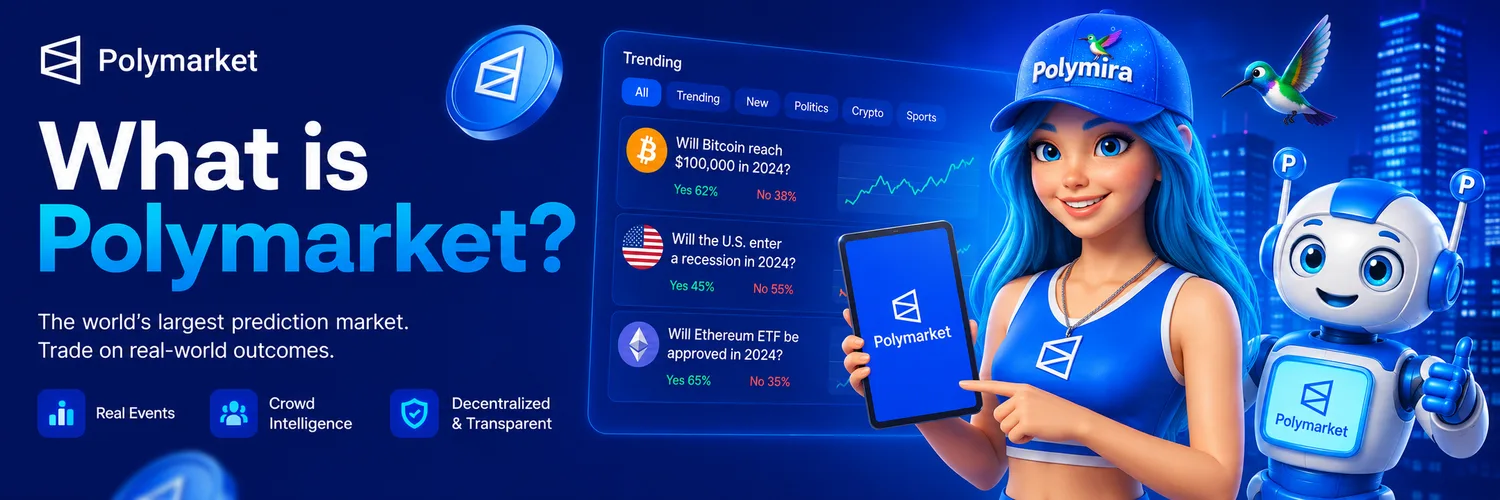
What is Polymarket?
Polymarket is the world's largest prediction market — a place where people trade on the outcomes of real-world events, from elections and crypto prices to AI milestones and sports. Prices aren't set by a bookmaker: they come from thousands of traders, and they double as live probabilities.
How a Prediction Market Works
Every Polymarket market is a simple question about the future: "Will X happen by date Y?" You buy YES or NO shares priced between $0.01 and $1.00. When the event resolves, correct shares pay out exactly $1 each — wrong shares expire at zero.
Price = Probability
A YES share trading at 65¢ means the crowd estimates a ~65% chance the event happens. Prices move in real time as news breaks — often faster than polls or headlines.
Peer-to-Peer, No House
You trade against other people in an open order book — not against a bookmaker who sets odds and profits when you lose. Supply and demand set every price.
Exit Anytime
You don't have to wait for the result. Sell your shares at the current market price whenever you want — lock in profit or cut a loss early.
How to Use Polymarket — Step by Step
From zero to your first trade in about ten minutes. No crypto experience required.
Deposit USDC
Fund with a bank card or crypto. Trades settle in USDC — a stablecoin worth $1 — on the Polygon network, so fees are near zero.
Pick a Market
Browse elections, crypto, sports, AI, culture — or start from our New Markets feed and AI signals.
Buy YES or NO
Read the resolution rules first — they define exactly what counts as YES. Then buy the side you believe in at the current price.
Sell or Hold
Sell anytime at market price, or hold to resolution — correct shares redeem for $1 each. Outcomes are verified by the decentralized UMA oracle.

Who Founded Polymarket?
Shayne Coplan — Founder & CEO
Polymarket was founded in 2020 by Shayne Coplan, born June 1998 and raised in Manhattan. He discovered crypto as a teenager and became the youngest participant in the 2014 Ethereum sale — at just 15. He enrolled in computer science at New York University, dropped out in 2017 to build crypto projects full time, and watched several of them go nowhere before Polymarket.
The idea came from what he called rampant misinformation: if talk is cheap, make people back their claims with money. He launched in 2020 from a converted bathroom office in his apartment during lockdown, and the very first market asked when New York City would reopen.
The 2024 US election proved the thesis — over $3 billion traded on the presidential race, and Polymarket's odds became a daily reference for global media. Then came the hard part: in November 2024 the FBI raided his apartment; by July 2025 both the DOJ and the CFTC had closed their investigations without charges. In October 2025, after ICE bought up to 25% of the company, Coplan became the world's youngest self-made billionaire at 27. He remains CEO and the largest individual shareholder.
Funding & Valuation
| Date | Round | Raised | Valuation |
|---|---|---|---|
| 2020 | Seed Polychain Capital, 1confirmation + angels: Vitalik Buterin, Naval Ravikant, Balaji Srinivasan |
$4M | — |
| 2021 | Series A General Catalyst, Polychain |
$25M | $70M |
| May 2024 | Series B Founders Fund (Peter Thiel), Dragonfly, ParaFi, 1confirmation, Vitalik Buterin |
$45M | — |
| 2024 | Undisclosed Led by Blockchain Capital |
$55M | $350M |
| 2025 | Undisclosed Founders Fund, Ribbit, Valor, Point72 Ventures, SV Angel, 1789 Capital, Coinbase, Dragonfly |
$150M | $1.2B |
| Oct 2025 | Strategic Intercontinental Exchange (ICE), owner of the NYSE — also global distributor of Polymarket data |
up to $2B | $9B |
| Mar 2026 | Follow-on ICE — completing its $2B commitment (~4.2M Series E preferred shares) |
$600M | ~$15B |
| 2026 | In talks Reported negotiations for a new round |
~$1B | $20B+ |
Polymarket raised about $279M across all rounds before ICE stepped in. The March 2026 $600M is part of ICE's $2B commitment, not on top of it. Backers span Silicon Valley venture capital, crypto-native funds and traditional finance — including D.E. Shaw, G Squared and Joe Gebbia.
Polymarket vs Bookmakers
The difference isn't cosmetic — it's a different mechanism entirely.
| ✓ Polymarket | ✕ Traditional bookmaker | |
|---|---|---|
| Who sets the odds | Thousands of traders, via an open order book | The bookmaker's own oddsmakers |
| House edge | None — small taker fees (~0.75–1.8%), makers pay 0% | 5–10% margin built into every line |
| Exit early | Sell anytime at market price | Bet is usually locked until the event ends |
| What prices mean | Live probabilities, cited by media & researchers | Odds skewed by the built-in margin |
| Coverage | Elections, crypto, AI, geopolitics, culture, sports | Mostly sports |
| Settlement | USDC on-chain, decentralized UMA oracle | The bookmaker decides and pays |
Is Polymarket Legal?
A short history of the road back to the US market.
CFTC settlement ($1.4M) — Polymarket blocks US users and operates internationally.
The US election makes Polymarket a household name — $3B+ traded on the presidential market.
DOJ and CFTC close their investigations. Polymarket acquires QCEX, a CFTC-licensed exchange, for $112M.
Polymarket officially relaunches in the United States as a regulated exchange.
Polymarket, Live on Polymira
We watch Polymarket 24/7 so you don't have to — fresh markets and AI-analyzed signals, free.
🤖 Fresh AI Predictions
See all →Our AI agent researches live news and Polymarket odds, then publishes signals with verdicts around the clock. Open the live feed →
✨ New Markets Today
See all →Dozens of new markets open on Polymarket every day. We track them the moment they appear — with community reactions and stats. Browse new markets →
Polymarket FAQ
What is Polymarket in simple terms?
Polymarket is the world's largest prediction market — a platform where people trade on the outcomes of real-world events. Every market is a YES/NO question. Share prices range from $0.01 to $1.00 and reflect the crowd's probability estimate: a YES share at 65¢ means the market sees roughly a 65% chance the event happens. If you're right, each share pays out $1.
Who founded Polymarket?
Polymarket was founded in 2020 by Shayne Coplan, a New York University dropout who launched the platform at age 21 during the pandemic. In October 2025, after ICE (owner of the New York Stock Exchange) invested, Coplan became the world's youngest self-made billionaire.
Is Polymarket legal in the US?
Yes. After acquiring QCEX, a CFTC-licensed exchange and clearinghouse, for $112 million in July 2025, Polymarket officially relaunched in the United States in December 2025. Availability of specific markets can still vary by jurisdiction.
Do I need cryptocurrency to use Polymarket?
Trades settle in USDC — a stablecoin pegged 1:1 to the US dollar — on the Polygon blockchain. You can deposit crypto directly or use a bank card; the platform converts your deposit automatically, so no crypto experience is required.
How does Polymarket make money?
For most of its history Polymarket charged no trading fees. Since late 2025 it has introduced small taker fees on most categories (roughly 0.75%–1.8% depending on the market), while makers pay 0%. That's still far below the 5–10% margin built into bookmaker odds.
Can I sell my position before the event ends?
Yes. Polymarket is an order-book exchange, so you can sell your shares to other traders at the current market price at any time — locking in a profit or cutting a loss without waiting for resolution.
Who decides the outcome of a market?
Each market has written resolution rules. Outcomes are settled through a decentralized oracle process (UMA), where independent token holders verify the real-world result; disputed resolutions go through an escalation process. No single referee decides who wins.
How is Polymarket different from a bookmaker?
A bookmaker sets the odds and profits when you lose. On Polymarket you trade against other people: prices are set by supply and demand in an open order book, there's no house edge, you can exit early by selling, and prices double as real-time probability estimates cited by media worldwide.
What was the biggest market in Polymarket history?
The 2024 US presidential election, with more than $3 billion traded on the main market. Polymarket's odds during that campaign were cited daily by global media as a faster, market-driven alternative to polls.
How accurate are Polymarket odds?
Prediction market prices aggregate the views of thousands of traders who back their opinions with money, and they're typically well-calibrated: events priced at 70% happen roughly 70% of the time. Not a crystal ball — but they update faster than polls and headlines. That's also the data our AI predictions build on.
Ready to see what the world is betting on? 👀
Start with the odds — stay ahead with the AI 🚀
Trading involves risk. Nothing on this page is financial advice. Disclaimer